

The delivery-app bargain looked good in 2020 and looks expensive now: 20–30% of every order, plus the customer relationship itself. A commission-free online ordering system doesn't mean abandoning the apps — it means owning enough of your demand that they become optional.
Key takeaways
- App commissions of 15–30% often exceed a restaurant's entire margin on an order.
- Your own ordering channel costs only payment processing — no per-order commission.
- Orders should arrive in the same queue as walk-ins and fire to the kitchen normally.
- The hard part is promotion, not technology — get the link in front of existing customers.
- Keep the apps for discovery; convert app customers into direct customers.
The arithmetic
For a restaurant with a 65% gross margin on food, on a $45 order:
| Third-party app | Direct online | |
|---|---|---|
| Order value | $45.00 | $45.00 |
| Food cost (35%) | –$15.75 | –$15.75 |
| Commission (25%) | –$11.25 | $0 |
| Processing (~2.7%) | included | –$1.22 |
| Gross contribution | $18.00 | $28.03 |
That's a 56% improvement in contribution per order — for the identical food, kitchen and staff. At 40 online orders a week, it's about $20,000 a year.
Your owned channels
Hosted online menu
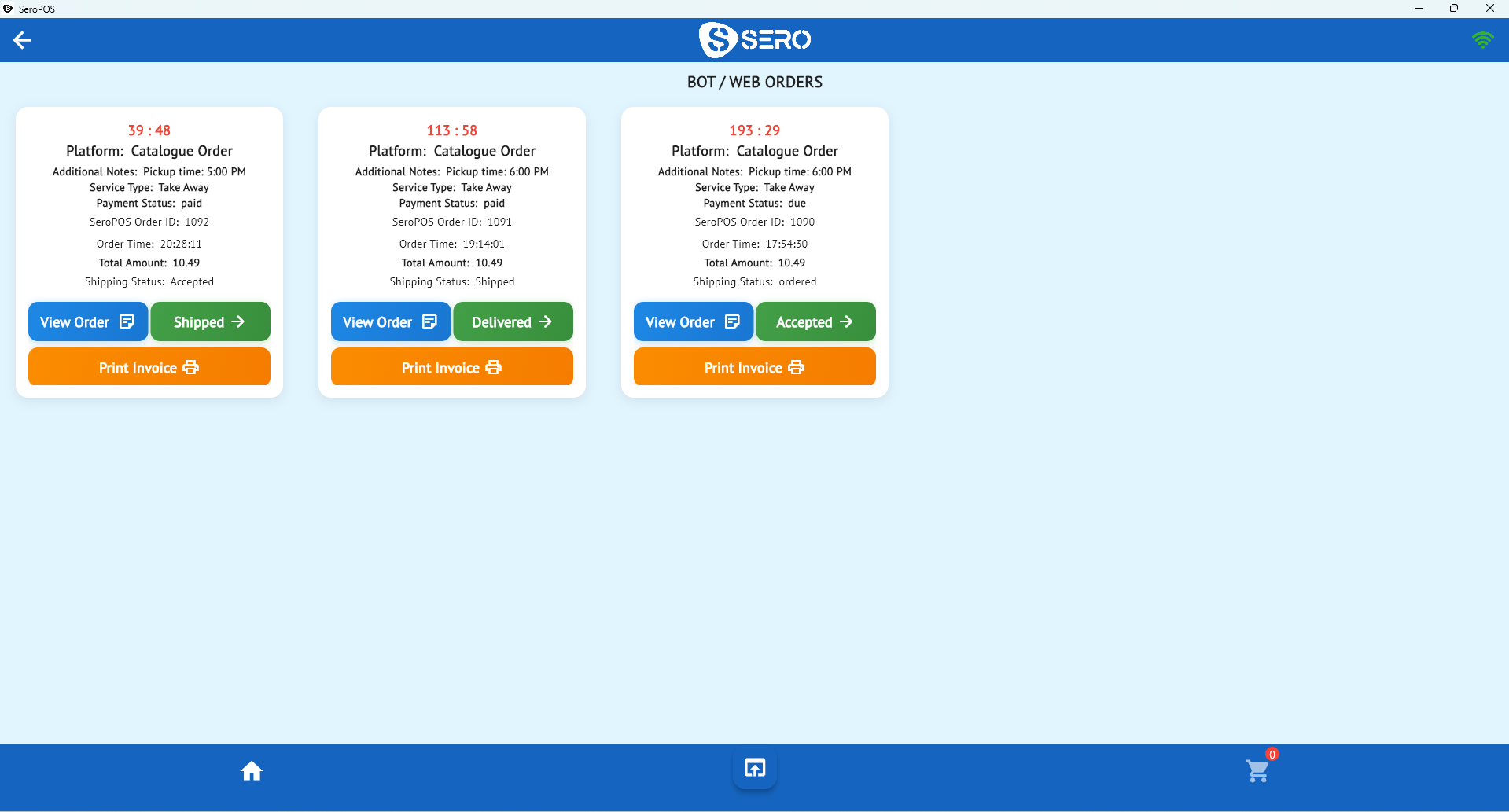
SeroPOS includes a customer-facing catalogue with cart and checkout, built from the same products and modifiers as your register:
- One place to update prices and availability
- Payment through Stripe with PCI compliance handled
- Orders land in your queue and print to the kitchen like any other
QR code ordering
A QR code for tables, counters, packaging and flyers, opening your live menu in the browser — no app download. See the QR ordering guide for placement and design detail.
Phone (including AI)
Phone is still a major channel for many restaurants. If you're missing calls at peak, AI phone ordering answers every one and puts the order in the same queue.
Promotion: where the real work is
Building the page takes an afternoon. Getting people to use it is the job:
- Google Business Profile. Add your direct ordering link. This is the single highest-impact placement — many customers search, see your listing, and click the first ordering option.
- Packaging and receipts. A QR code on every takeaway bag reaches people who already chose you.
- Social bios. Where regulars look you up.
- A modest direct incentive. Loyalty points or a small freebie over a threshold — dramatically cheaper than commission.
- Tell people in person and on the phone.
- Door and counter signage for walk-ins who'll order in later.
Make the direct experience genuinely good
Customers default to apps because apps are easy. Match them on the basics:
- Accurate menu — 86'd items off the menu, not discovered after checkout
- Honest prep times — under-promise, over-deliver
- Short checkout — no forced account creation
- Clear confirmation — people need to know it landed
- Mobile-first — most orders come from a phone
Where third-party apps still earn their fee
Discovery. Apps put you in front of people who've never heard of you, and that's genuinely valuable. Treat the commission as an acquisition cost and convert:
- Include a QR sticker or flyer in every app delivery
- Offer loyalty points only on direct orders
- Keep pricing consistent so direct never looks like a downgrade
Operational fit
Online ordering only helps if it doesn't break service. Ensure orders arrive in the same queue as walk-ins, fire to the kitchen display or printer automatically, and can be paced when the kitchen is buried. If you deliver yourself, delivery management covers zones, batching and driver settlement.
Measure it
- Share of orders by channel (direct vs. app)
- Direct order growth month over month
- Average per cheque by channel — direct often runs higher
- Repeat rate among direct customers
Your sales reports carry most of this.
Online ordering, QR menus and the order queue are all included in SeroPOS with no per-order fees — see pricing or download the app for a 14-day free trial.