
Ask ten pizzeria owners what a large pepperoni costs them to make and you’ll get ten estimates, most of them optimistic. Pizza food cost is knowable to the cent — and knowing it is the difference between pricing on instinct and pricing on facts.
Key takeaways
- Cost each pizza by component: dough, sauce, cheese, toppings — cheese is usually the volatile one.
- Target 25–33% food cost; recalculate whenever cheese moves more than ~10%.
- Portion drift is the most common invisible margin leak — weigh, don't eyeball.
- Unpriced modifier options quietly give away toppings; audit your upcharges.
- Recipe management in SeroPOS costs pizzas automatically once ingredients and portions are entered.
Building the cost of one pizza
Work bottom-up. A worked example for a 16” pepperoni (use your own supplier prices — these are illustrative):
| Component | Portion | Unit cost | Cost |
|---|---|---|---|
| Dough ball | 1 × 450 g | $0.85 each | $0.85 |
| Sauce | 120 ml | $6.00 / 3 L | $0.24 |
| Mozzarella | 280 g | $11.50 / kg | $3.22 |
| Pepperoni | 90 g | $14.00 / kg | $1.26 |
| Box + liner | 1 | $0.42 | $0.42 |
| Total | $5.99 |
Sell that pizza at $21.99 and your food cost is 27.2% — healthy. But notice what dominates: cheese is more than half the food cost. A 15% jump in mozzarella adds ~$0.48 per pizza, and across 200 pizzas a week that’s $5,000 a year straight off your bottom line.
Food cost percentage, quickly
The formula is simple:
Food cost % = (Cost of ingredients ÷ Menu price) × 100
For the whole shop over a period:
Food cost % = (Opening inventory + Purchases − Closing inventory) ÷ Food sales × 100
The per-item version tells you which menu items earn their place. The period version tells you whether reality matches your recipes — and the gap between the two is your waste, theft, and portion drift.
Where pizzerias actually leak margin
Portion drift. The single biggest offender. A cook who adds “just a bit extra” cheese on every pizza — say 40 g — costs you about $0.46 per pizza. At 1,000 pizzas a month that’s $5,500 a year, invisible on any report.
Fix: portion scales at the make line and a weighed reference pizza. Retrain quarterly, without drama — most staff have no idea what 280 g looks like.
Unpriced modifiers. An option list where “extra cheese” carries no upcharge is a standing invitation to give away your most expensive ingredient. Audit every modifier group; see the modifier setup guide.
Unrecorded waste. Dropped pizzas, mistakes, and staff meals belong in a waste log. Not because you’ll eliminate them, but because unexplained variance is the thing that hides a real problem.
Stale menu prices. If your prices haven’t moved in two years but your suppliers’ have, your margin has already eroded — you just haven’t measured it.
Letting the POS do the arithmetic
Recalculating spreadsheets by hand is why most shops don’t. On the SeroPOS Pro plan, recipe management lets you:
- Enter ingredients with their unit costs
- Define recipes with portions per menu item
- See the cost per pizza update automatically when an ingredient cost changes
- Deduct ingredient-level stock as pizzas sell, so your cheese inventory reflects reality
That turns costing from a quarterly chore into something that’s simply true in the background. See pricing for what’s on each plan.
Reading the numbers that matter
Your daily sales report already contains a lot of the story — bills, net sales, average per cheque, and category breakdowns.
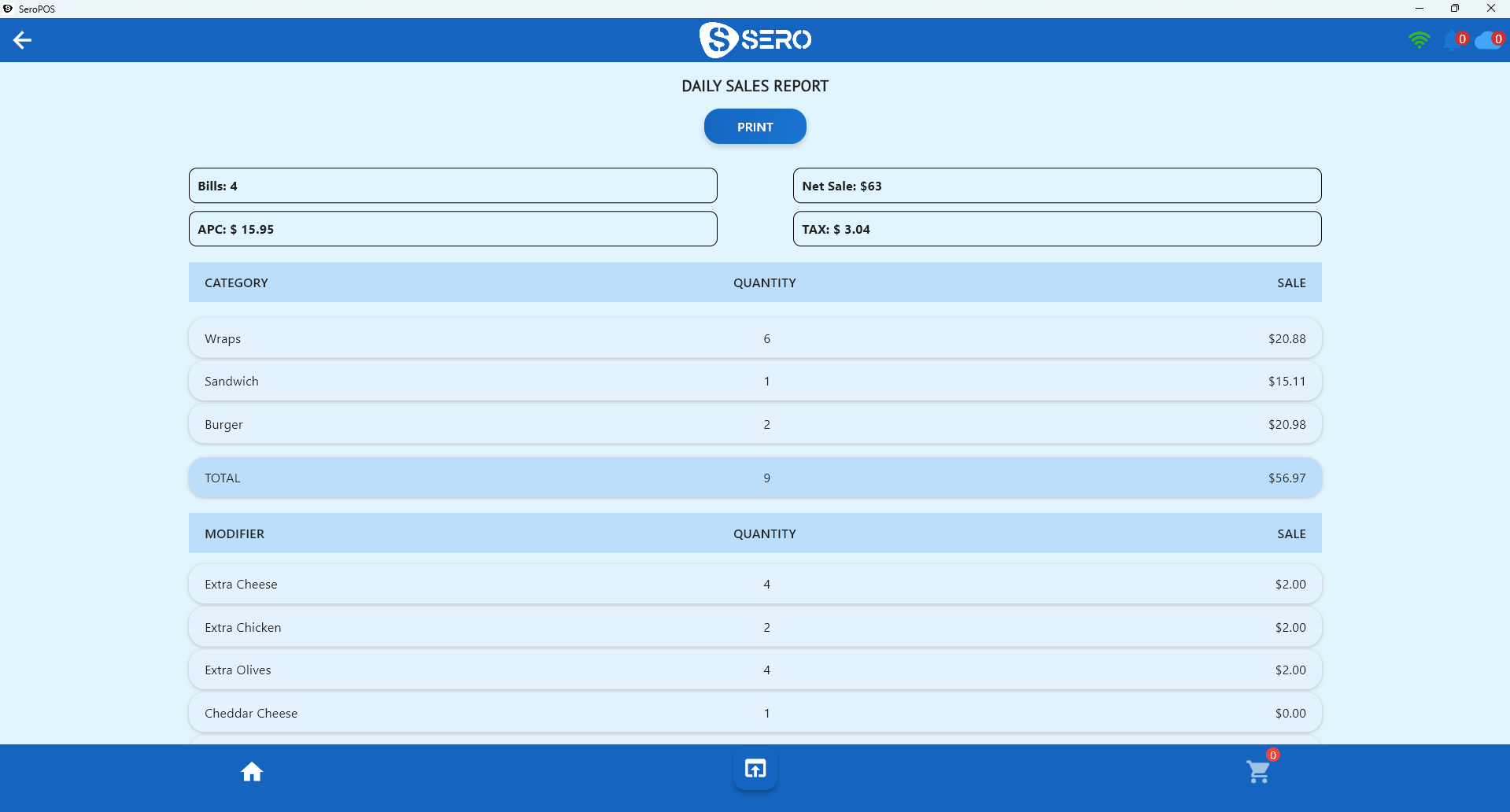
The modifier breakdown is especially useful for pizza: it shows exactly how many extra-cheese portions you sold, which you can check against your cheese usage.
A practical quarterly routine
- Recost your top ten sellers with current supplier prices.
- Weigh a sample pizza off the line — compare to your recipe spec.
- Compare theoretical vs. actual usage for cheese and your two priciest toppings.
- Audit modifier upcharges for anything set to $0 that shouldn’t be.
- Adjust prices in small increments where food cost has drifted above target.
Thirty minutes, four times a year. It’s the cheapest money you’ll ever make.
Price increases without losing customers
When you do need to raise prices: move in small steps ($0.50, not $2.00), don’t raise everything at once, keep your signature item’s price stable if you can, and never shrink portions to hide it. Customers forgive a modest increase; they don’t forgive a pizza that got worse.
Pair good costing with loyalty and commission-free ordering and you’re improving margin from three directions at once.
Download SeroPOS — 14-day free trial, no credit card required.