Delivery is where pizza makes its money — and where it loses it fastest. Handing every order to an app costs 20–30% off the top; running your own delivery badly costs you in idle drivers, cold pizzas, and cash that doesn’t reconcile. This guide covers pizza delivery management that actually protects your margin.
Key takeaways
- Draw delivery zones by drive time (10–15 minutes), not by distance on a map.
- Batch nearby orders — a driver carrying three orders is roughly three times more profitable than one carrying one.
- Track payment status per order so nothing leaves unpaid and unnoticed.
- Charge a delivery fee that reflects real driver cost, and set a sensible minimum order.
- Push customers toward prepaid direct orders — less cash handling, no commission.
The delivery math nobody does
Take a driver paid $18/hour plus mileage. In one hour they can realistically complete:
| Orders per run | Runs per hour | Orders/hour | Driver cost per order |
|---|---|---|---|
| 1 | 2.5 | 2.5 | ~$7.20 |
| 2 | 2 | 4 | ~$4.50 |
| 3 | 1.7 | 5 | ~$3.60 |
The lesson is stark: batching is everything. A tight delivery zone with clustered orders makes in-house delivery genuinely profitable. A sprawling zone with one-off runs to the edge of town does not — and that’s exactly the situation where a delivery app’s commission starts to look reasonable.
Setting zones that work
- Time, not distance. Fifteen minutes on a clear road is a very different radius than fifteen minutes through downtown at 6 PM. Set zones by realistic drive time in your busiest hour.
- Cut the awkward edges. If one direction has a bridge, a highway, or a rail crossing, pull the boundary in.
- Different fees per zone. Near zone $3, far zone $6, with a higher minimum order. Customers accept this readily.
- Say no politely. Out-of-zone callers should get “we don’t deliver there, but pickup is ready in 15 minutes” — not a driver gone for 40 minutes.
Running the flow in SeroPOS
Every delivery order should carry the information the driver needs and the status the shop needs:
- Order taken — at the counter, online, via QR, or through AI phone ordering. Customer name, phone, and address attach to the order.
- Accepted — visible in the order queue with service type “Delivery.”
- Fired to the kitchen — kitchen ticket prints with the pizza spec.
- Out for delivery — assigned to a driver, status updated.
- Delivered — payment settled (already paid online, or collected at the door).
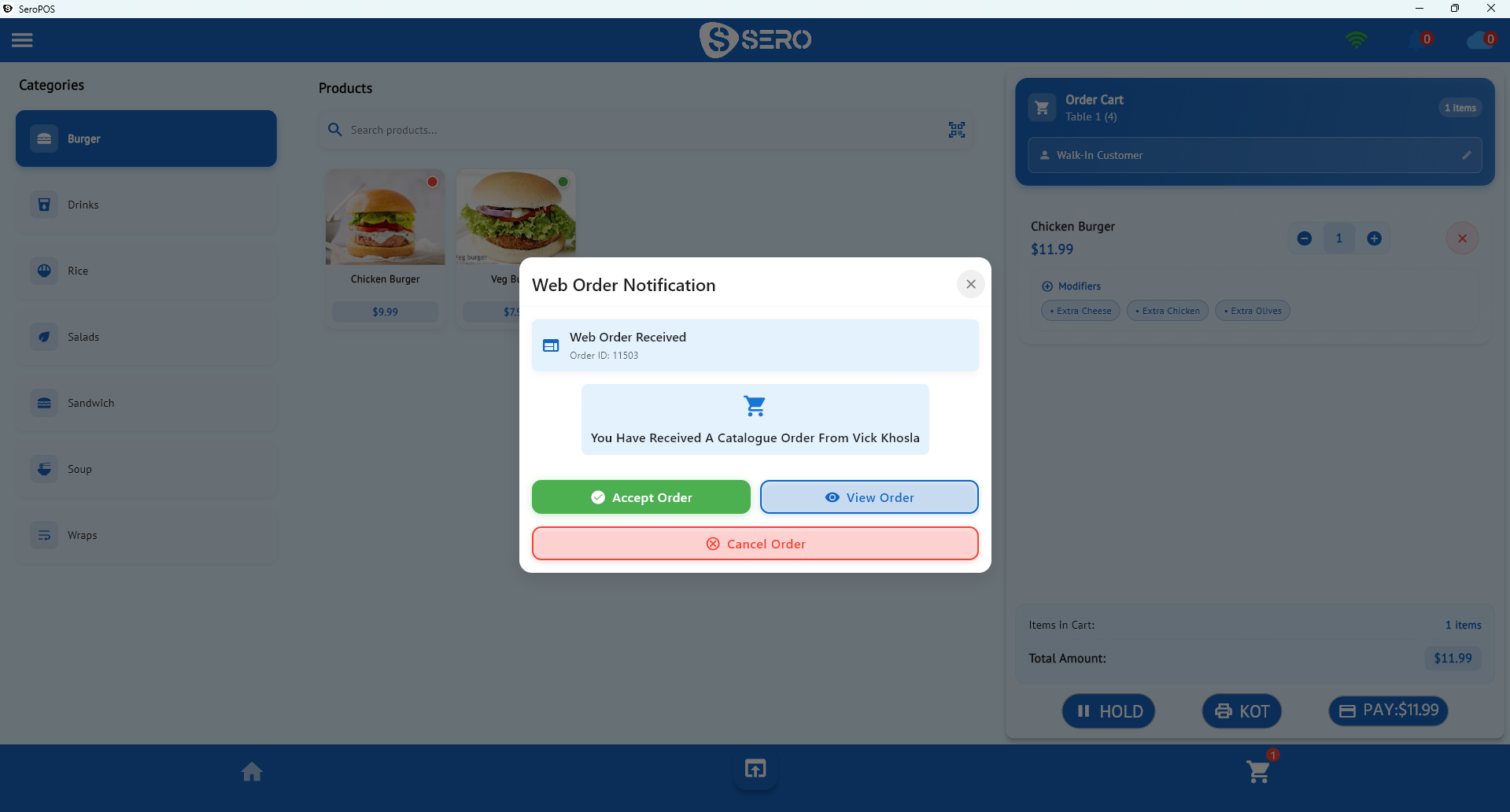
Because the status lives on the order, “did table 4’s delivery go out?” is a glance, not a shout across the kitchen.
Money control on the road
Cash on delivery is the leakiest part of most pizzerias. Tighten it:
- Prefer prepaid. Push direct online ordering with payment at checkout. Every prepaid order is one less cash handoff.
- Portable terminals for the door. Card at delivery beats cash — see the Canadian payments guide for integrated Global Payments and Moneris setups.
- Per-driver float and settle-up. Fixed float at shift start, settle against the orders assigned to that driver at shift end.
- Reconcile daily. Your daily sales report shows cash vs. card totals; a mismatch should be caught the same night, not next month.
Keeping pizza hot and customers happy
Operational details that quietly drive repeat business:
- Insulated bags, actually used. The cheapest quality upgrade available.
- Honest ETAs. Quote 40 minutes and arrive in 35 rather than quoting 25 and arriving in 40.
- Route the run, don’t wing it. Group by direction; drop the closest last-in-first if it keeps others hot.
- Cook to the run. If two orders are heading the same direction, time them out of the oven together.
When to use the apps anyway
Being pragmatic: apps are worth it for discovery and for overflow on nights you can’t staff a second driver. The mistake is letting them own your customer relationships permanently. Include a QR sticker or flyer with every app delivery, and make direct ordering worth it with loyalty points.
Know your numbers
Delivery decisions should be data-driven, and the data is in your POS: which zones order most, what your average delivery ticket is versus pickup, which nights justify a second driver. Pair that with proper pizza food costing and you’ll know exactly which orders are worth driving across town for.
Download SeroPOS and run your deliveries through the 14-day free trial — no credit card, no contract.