Every pizzeria owner knows the sound of money walking away: the phone ringing at 6:40 PM on a Friday while three staff members have dough on their hands and a fourth is running a delivery. AI phone ordering exists to solve exactly that moment — an assistant that answers instantly, takes the whole order correctly, and puts it in your queue without anyone stopping what they’re doing.
Key takeaways
- Phone orders remain a huge share of pizza revenue — and they're the orders you're most likely to drop during a rush.
- An AI order-taking assistant answers every call at once, so no caller hears a busy signal.
- Orders arrive in the same queue as your online and QR orders — no re-typing, no transcription errors.
- SeroPOS integrates with Inputly for AI voice ordering; usage-based pricing means you pay for calls actually handled.
- Staff get their hands back: fewer interruptions mid-build means faster tickets and calmer service.
The real cost of a missed call
Do the arithmetic for your own shop. If your average phone order is $35 and you miss six calls on a busy Friday because everyone was slammed, that’s $210 gone — from your busiest, most profitable hours. Repeat that Friday and Saturday every week and you’re looking at roughly $20,000 a year of orders that literally called you and got no answer.
Worse, a caller who gets voicemail rarely calls back. They call the next pizzeria on the list, and if that shop answers, you may have just donated a regular customer to a competitor.
Why the phone is still the hardest channel
Online ordering solved the “customer wants to order without talking” case. But the phone persists for good reasons: older customers, big group orders, people driving home, complicated custom requests, and anyone who wants to confirm the pizza is actually going in the oven now.
The problem is that answering a phone properly during a rush costs you a person. That person stops building pizzas, wipes their hands, finds a pen, asks the caller to repeat the address twice, and re-enters everything into the POS afterwards — where transcription errors sneak in.
How AI order taking works
SeroPOS integrates with Inputly, an AI voice assistant built for exactly this job. The flow looks like this:
- The call is answered instantly — every time, even if five people call at once.
- The assistant talks the customer through the order, using your live menu: sizes, crusts, toppings, sides, drinks, and the modifiers you’ve configured.
- It confirms the details — name, phone, pickup or delivery, address, timing.
- The order lands in your SeroPOS queue alongside web and QR orders, ready to accept and fire to the kitchen.
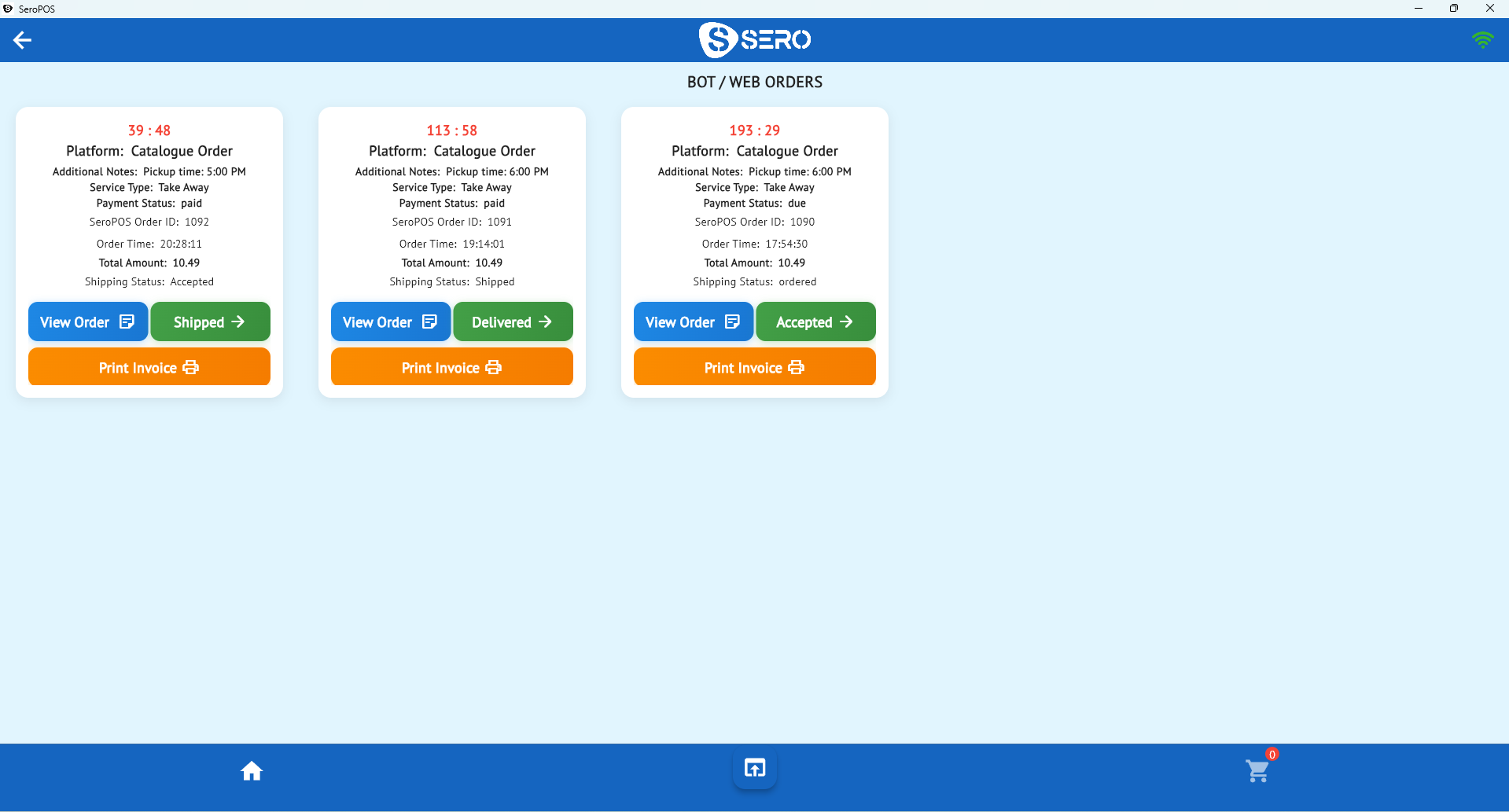
Because the assistant reads from the same catalogue as your register, it always quotes current prices and never sells a topping you’ve run out of — assuming your menu is up to date in the app.
What it changes on a Friday night
- No busy signal. Ten simultaneous callers all get answered.
- No transcription step. Nobody re-types a scribbled order into the POS.
- Fewer wrong orders. The assistant confirms back what it heard; the ticket prints exactly what was ordered.
- Calmer staff. The person building pizzas keeps building pizzas.
- A record of everything. Orders are logged, searchable, and reportable like any other sale.
What AI phone ordering is not
Being honest about limits matters more than overselling. An AI assistant is excellent at routine orders and repetitive questions (“are you open until 11?”, “do you deliver to X?”). It’s not a replacement for your staff’s judgment on a complicated catering request, a complaint, or a regular who wants to chat about last week’s order. The right setup hands those calls to a human.
It also won’t fix a menu that isn’t set up properly. If your modifier groups are a mess, the assistant will faithfully reproduce that mess — so it’s worth getting your pizza modifiers configured correctly first.
Pairing AI calls with your other channels
The most profitable pizzerias run several owned channels and treat delivery apps as marketing spend rather than infrastructure:
| Channel | Who it serves | Commission |
|---|---|---|
| AI phone ordering | Callers, big orders, older customers | Usage-based fee only |
| Your online menu | Planners, repeat customers | None |
| QR code at the counter/table | Walk-ins, dine-in | None |
| Third-party apps | Discovery of new customers | 20–30% |
Every order you shift from the last row into the first three rows goes almost entirely into your pocket. See commission-free online ordering for pizza shops for the setup details.
Getting started
AI phone ordering makes sense once you’re regularly missing calls — usually when you’re doing more than about 20 phone orders on a busy night. Before you switch it on:
- Get your menu clean in SeroPOS — correct sizes, crusts, toppings, and upcharges.
- Decide your handoff rule — which calls should always reach a human.
- Set delivery zones and timing expectations so the assistant quotes them accurately.
- Listen to the first day’s calls and tune the wording.
The rest of the platform — kitchen tickets, online ordering, delivery tracking, reporting — is already in the same app, so the AI orders flow through the same operation you run today.
Ready to see it working in your own shop? Download SeroPOS and start your 14-day free trial — no credit card, no sales call.